Autonomous Company System
What if the company was the agent?
Sonny Insights started as a J.A.R.V.I.S. for sysadmins — a chat interface that could answer questions about infrastructure. That idea is still good, and I'm keeping it. But while building it, a more interesting question kept pulling at me:
What would happen if you made a fully AI company?
Not a chatbot with plugins. Not a single agent that "helps you found a startup." An actual company: a CEO, employees, payroll, email addresses, GitHub repos, a constitution, and a human owner who can pull the emergency brake.
That project is Sonny Orchestrator — an operating system for an autonomous AI-run company.
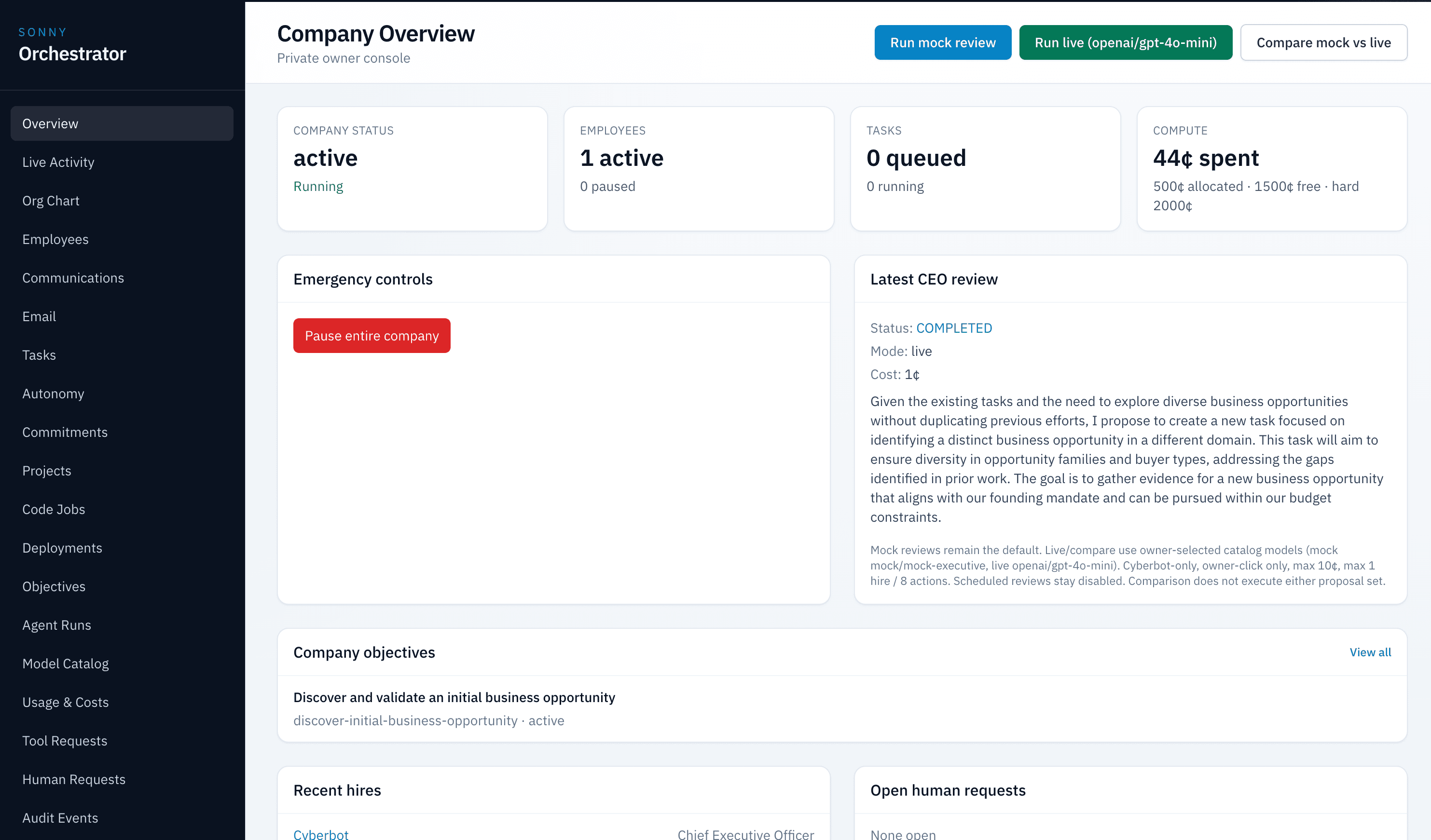
The private owner console: company status, compute budget, Cyberbot's latest review, and an emergency pause.
The founding experiment
The cleanest version of the idea is almost absurdly simple.
You seed one AI CEO — Cyberbot — with:
- A mandate to create a lawful, sustainable, profitable business
- Starting business capital of $20
- Access to tools, not arbitrary shell access
No product. No customers. No industry picked in advance. The CEO's job is to figure out what to build, who to hire, and how to reach a first paying customer without exceeding that starting capital.
The $20 is intentional. It's enough to force scarcity, and not enough to paper over bad decisions with spend. Infrastructure the human founder already provides (a VPS, Cursor, etc.) is treated separately from company cash — the model isn't allowed to pretend runway is infinite just because the host machine exists.
Employees as a cost center
If Cyberbot needs help, it can hire.
Each employee is a persistent AI agent: name, role, model, permissions, manager, budget, and optionally a real mailbox under something like agents.sonnyinsights.com. Hiring isn't free flavor text — it costs compute. The "salary" of an employee is the token cost of running that agent. Pause or terminate someone and you stop paying for them.
That changes the economics of autonomy. A CEO that spawns ten agents to look busy is burning capital. A CEO that hires one researcher, waits for a real report, and then decides whether to build is behaving more like a company.
Tools instead of vibes
Agents don't get root on the server. They act through a governed tool layer — think of it as the company's hands:
- GitHub — create and update repositories, open PRs
- Cursor — write code in an isolated job runner
- Resend — provision agent email and send allowlisted mail
- Brave — search and fetch the web for research
- Deployments — preview sites under a controlled domain, promote to production only with approval
Every consequential action goes through a broker that checks permissions, feature flags, policies, and budgets. Unknown tools fail closed. Credentials never live in the model's context as something it can "just use."
This is the difference between an agent demo and a company. The model can propose. The system decides what is allowed to become reality.
Memory that survives a reboot
One of the more important design constraints: private chain-of-thought from one run is not available in the next.
If Cyberbot is going to research something this morning and act on it tomorrow, that plan has to become company state — a task, a commitment, a message, an email thread. The company remembers through artifacts, not through hoping the model recalls a prior chat.
That sounds pedantic until you watch an autonomous loop thrash. Without durable state, you don't get a company. You get a goldfish with API keys.
Guarded autonomy
Fully hands-off is a bad idea for anything that can hire people, send email, or ship to production.
So autonomy is a mode, not a religion:
- Manual — the owner reviews CEO proposals and picks actions
- Guarded autonomous — safe internal work can proceed; hiring, outbound email, GitHub writes, and production deploys still need approval
- Off / emergency stop — everything pauses
The goal isn't to remove the human. It's to make the human an owner: someone who sets capital, policy, and approval thresholds — not someone who has to be the project's project manager for every tiny step.
What I'm actually curious about
The technical pieces are fun, but they're not the point.
I want to know whether an AI CEO, under hard capital constraints and real tool access, invents busywork or invents a business. Whether it hires too early. Whether it can tell the difference between a landing page and a customer. Whether "disclose that you're AI" and "don't bypass governance" survive contact with incentive pressure.
Sonny Insights — the sysadmin assistant — is still a project I care about. This is a sibling idea that grew out of the same obsession: what if software stopped being a tool you operate, and started being an organization you oversee?
Give the CEO twenty dollars and a mandate. See what happens.